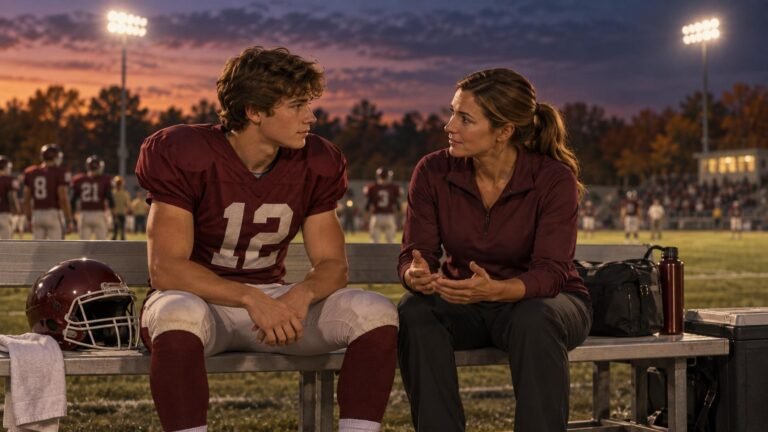
AI-generated editorial illustration; fictional scene.
When a child is hurt during a game, parents usually have more immediate concerns than a legal claim. They need to arrange treatment, understand the injury and figure out what school will look like over the next few days. Questions about what happened on the field often come later.
Those questions can be difficult. A hard tackle can cause a serious injury during a properly coached game. A student who stays in the game after an adult responsible for the student suspects a concussion raises questions about the response after the hit. Equipment, supervision and medical decisions may each need a closer look.
South Carolina law accounts for the risks players accept when they participate in sports. It also addresses responsibilities that may fall on schools, coaches and healthcare professionals. The type of claim, the people involved and whether the school is public or private all affect the rules that apply.
The risks players accept by joining a game
In Cole v. Boy Scouts of America, the South Carolina Supreme Court considered a collision during a father-son softball game. The injured catcher sued the baserunner who collided with him. The court upheld judgment for the baserunner.
The court explained that participants in contact sports accept certain risks within the game, including some ordinary recklessness. A player can make an aggressive or poorly judged play, and even break a playing rule, without necessarily becoming legally responsible for another participant’s injury.
The court drew a line at intentional injury and conduct so reckless that it falls outside the game’s scope. That requires looking at what the player actually did and how it relates to the sport. Describing a play as “reckless” begins the discussion; the details determine whether it crosses the legal line.
The appeal in Cole concerned the claim against a fellow player. A claim about a coach’s supervision, faulty equipment or medical treatment asks different questions about the responsibilities of the person or institution involved. For example, an investigation might examine a known equipment problem, an earlier warning to a coach or a decision to put a student back into a game after concerning symptoms. These are hypothetical examples of issues to investigate.
If you suspect a concussion, get the student out of play
The CDC advises removing an athlete immediately when a concussion is suspected and keeping the athlete out for the rest of that day. A healthcare provider should assess the athlete and clear the athlete before a return to sports. Parents and coaches should leave the diagnosis and assessment of severity to a healthcare provider.
Some symptoms require emergency medical care. After a head injury, call 911 or go to an emergency department for danger signs such as repeated vomiting, seizures, a worsening headache that does not go away, increasing confusion, slurred speech, weakness or difficulty waking the child. The CDC lists additional danger signs as well.
Symptoms can also take time to appear. Tell the treating clinician about changes in the child’s balance, thinking, behavior, sleep or schoolwork, including changes you notice later at home. Follow the clinician’s instructions about recovery and activity.
What South Carolina requires for student-athlete concussions
South Carolina Code Section 59-63-75 addresses concussion procedures for student athletes. Its guidelines apply to events sanctioned by the South Carolina High School League, and local school districts must develop guidelines and procedures. The statute’s definition of student athlete includes cheerleaders.
Schools must provide annual concussion information to coaches, volunteers, student athletes and parents or guardians. Receipt by the parent or guardian must be documented before the student participates in practice or competition. That is one reason to keep the information sheets and forms you receive at the start of the season.
When the student must be removed
The law requires removal from practice or competition when a coach, athletic trainer, official or physician responsible for the student suspects a concussion or brain injury. The requirement starts with suspicion. The adult does not need to wait for a confirmed diagnosis before removing the student.
Who can evaluate a return to play
The statute describes two situations that parents should understand.
First, after removal, an on-site evaluation by one of the listed healthcare professionals may result in a professional determination that the student has no signs or symptoms of a concussion or brain injury. The statute allows return under that provision. The listed professionals include an athletic trainer or physician, and a physician assistant or nurse practitioner meeting the statute’s practice requirements.
Second, if the student has been removed, evaluated and is suspected of having a concussion or brain injury, the student must receive written medical clearance from a physician before returning. A parent’s permission or a coach’s reassurance does not replace the required medical decision.
Parents may notice a difference between this wording and the CDC’s advice to keep an athlete with a suspected concussion out for the rest of the day. The statute describes the legal evaluation and clearance process. The CDC gives more conservative same-day health guidance. Ask for the school’s written protocol, share it with the treating clinician if needed and follow the clinician’s directions.
Private clubs, recreational leagues and activities outside the High School League’s sanctioned events may operate under different rules. Identify the program your child was participating in and request the policy that applied to that particular practice or game.
Public-school claims have a higher threshold for some conduct
A public school is a government entity. Claims against it may be governed by the South Carolina Tort Claims Act, which sets out situations in which a public entity is protected from liability and situations in which a claim can proceed.
For governmental responsibilities involving a student’s supervision, protection, control or custody, Section 15-78-60(25) preserves immunity unless the responsibility or duty was exercised in a grossly negligent manner. “Immunity” means legal protection from liability. “Gross negligence” is a higher threshold than ordinary carelessness.
In Clyburn v. Sumter County School District 17, the Supreme Court explained the difference in terms of ordinary care and even slight care. Ordinary negligence involves failing to use ordinary care; gross negligence involves failing to use even slight care. The school district won that case on its facts.
Clyburn involved a student attack, so its usefulness here is the explanation of the supervision standard. In a sports injury case, an attorney would examine what adults knew, what responsibility they had and what steps they took. A parent’s understandable disagreement with a decision still has to be evaluated under the legal standard that governs the particular claim.
Other provisions of the Tort Claims Act may affect the analysis, including limits on recovery and procedures for bringing a claim. A private school requires a separate assessment of the rules that apply to it.
The medical evaluator’s role can matter too
Section 59-63-75(D)(5) provides civil-immunity protections for specified healthcare professionals who evaluate a student during practice or competition and authorize a return to play. It includes exceptions for gross negligence or willful, wanton misconduct and also addresses volunteers.
Keep a record of who evaluated your child and who authorized any return. A job title, written clearance or treatment note may help an attorney determine which duties and legal protections apply to that person’s decisions.
Check deadlines while treatment and school planning continue
Claims against public entities can have different deadlines and procedures from claims against private parties. Under Section 15-78-110, a Tort Claims Act claim generally has a two-year filing period. A qualifying statutory claim filed first can allow a three-year period. Rules involving minors and other exceptions can affect the deadline.
Ask an attorney to identify the deadline for your child’s circumstances. Explain any reports you made to the school and provide copies. A conversation with the athletic director or a school incident report serves a different purpose from the legal filings required to preserve a claim.
Contact Proffitt & Cox in Columbia to discuss a South Carolina school sports injury. Bring the timeline, school communications and medical records you have. That information can help the attorney explain which questions need further investigation and what evidence would help answer them.
This article provides general legal and health information. Seek medical care for a suspected concussion and individualized advice about legal questions. Hypothetical examples do not describe allegations against a named school, league or team.