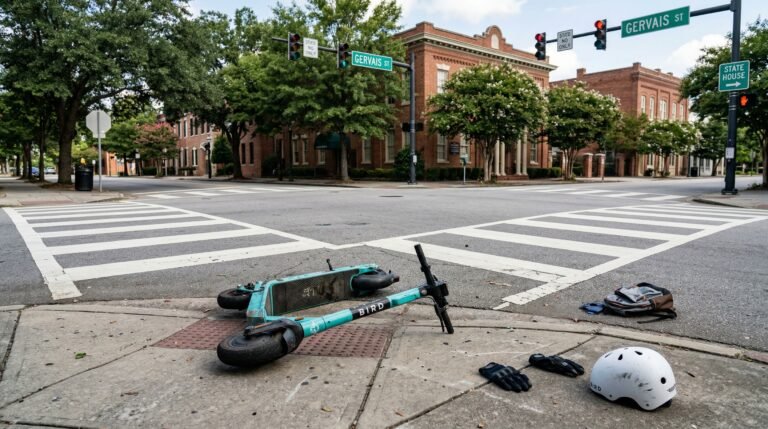
Electric scooters and e-bikes have become a common sight on Columbia streets. They’re convenient, affordable, and increasingly popular for short trips around downtown, the Vista, and Five Points. But as their use grows, so do accidents—and the legal questions that follow.
When an e-scooter rider gets hit by a car, or an e-bike collides with a pedestrian, who’s responsible? The rider? The driver? The scooter rental company? The answers aren’t always straightforward, and South Carolina’s patchwork of state laws and local ordinances adds to the confusion.
South Carolina’s Legal Framework: A Gray Area
Unlike traditional bicycles or motor vehicles, e-scooters and e-bikes exist in a regulatory gray zone. South Carolina has some statewide rules, but gaps remain—and cities like Columbia have filled them with their own ordinances.
E-Bike Classifications
South Carolina recognizes three classes of e-bikes:
- Class 1: Pedal-assist only, up to 20 mph
- Class 2: Throttle-capable, up to 20 mph
- Class 3: Pedal-assist up to 28 mph (helmet required)
All classes must have motors producing no more than 750 watts. E-bike riders are generally subject to the same traffic laws as traditional cyclists, including obeying signals, yielding to pedestrians, and riding as far right as practicable unless preparing to turn or when unsafe.
E-Scooter Rules: EPAMDs and Beyond
Stand-up electric scooters that meet the definition of an “Electric Personal Assistive Mobility Device” (EPAMD) are governed by S.C. Code § 56-5-3310. To qualify as an EPAMD, a scooter must:
- Be self-balancing with two non-tandem wheels
- Transport only one person
- Have an electric motor averaging 750 watts
- Have a maximum speed under 20 mph on level ground
If your scooter meets these criteria, you can ride it on sidewalks, roads, bike lanes, and trails—but you must:
- Exercise due care and yield to pedestrians
- Not exceed 15 mph
- Use a front white light and reflectors at night
- Give an audible signal before passing
However, many modern e-scooters exceed 20 mph and don’t fit the EPAMD definition. Faster scooters (up to 25 mph) may be regulated as mopeds, requiring a valid driver’s license and a helmet for riders under 21.
Columbia-Specific Restrictions
The City of Columbia has stricter rules:
- E-scooters are prohibited on any public sidewalk
- Riders cannot use roads with speed limits of 25 mph or higher
- Helmets with chin straps and reflectors are mandatory
- Parking is restricted to designated public areas
Violating these local ordinances can result in fines—and can also be used as evidence of negligence in a personal injury claim.
Who’s Liable When an Accident Happens?
South Carolina follows a modified comparative negligence rule under S.C. Code § 15-38-15. This means you can recover damages as long as you’re less than 51% at fault. If you’re 30% at fault, your compensation is reduced by 30%. If you’re 51% or more at fault, you recover nothing.
In e-scooter and e-bike accidents, several parties may share liability:
1. The Motor Vehicle Driver
If a driver hits an e-scooter or e-bike rider, the driver may be liable for:
- Failure to yield
- Distracted driving (texting, phone use)
- Speeding or reckless driving
- Driving under the influence
- Following too closely or failing to maintain a safe distance
Even if the rider violated a traffic law, the driver can still be held partially or fully responsible depending on the circumstances.
2. The E-Scooter or E-Bike Rider
Riders have a duty to operate safely. Negligent actions that can reduce or eliminate recovery include:
- Riding on prohibited roads or sidewalks (in violation of local ordinance)
- Failing to signal turns
- Riding at night without lights or reflectors
- Exceeding speed limits
- Operating under the influence of drugs or alcohol
- Ignoring traffic signals or stop signs
3. Rental Companies
In cities where e-scooter rentals are permitted, companies like Lime, Bird, or Spin could be liable if:
- The scooter had defective brakes, lights, or steering
- The company failed to maintain the fleet properly
- The app or device provided inadequate safety warnings
- The rental agreement unlawfully attempted to waive liability for the company’s own negligence
Note: Liability waivers signed through an app have limits. Under South Carolina law, companies generally cannot waive liability for their own negligence or for defective products.
4. Manufacturers or Retailers
If the accident was caused by a product defect—such as faulty brakes, battery fires, or frame failures—the manufacturer or seller may be held liable under product liability law, even if the rider or owner did nothing wrong.
What to Do After an E-Scooter or E-Bike Accident
If you’ve been injured:
- Seek medical attention immediately. Some injuries (like concussions or internal bleeding) aren’t obvious at first.
- Document the scene. Take photos of your injuries, the vehicle, the scooter or bike, road conditions, and any traffic signs.
- Get contact information from the driver, witnesses, and any passengers.
- Report the accident. If a motor vehicle was involved, call the police and file a report.
- Do not sign anything from an insurance company without consulting an attorney.
- Preserve evidence. Keep the damaged scooter or bike, your helmet, clothing, and any receipts or rental records.
Time Limits: The Three-Year Statute of Limitations
Under South Carolina law, you generally have three years from the date of the accident to file a personal injury lawsuit. If you wait too long, you lose your right to recover compensation—no matter how strong your case.
The Bottom Line
E-scooters and e-bikes are here to stay, but South Carolina law hasn’t fully caught up. Liability in these accidents depends on who was at fault, whether local ordinances were violated, and whether equipment was properly maintained. Insurance coverage is often unclear, and rental companies will use every tool available to limit their responsibility.
If you or someone you love has been injured in an e-scooter or e-bike accident in Columbia or anywhere in South Carolina, you need an experienced personal injury attorney who understands the evolving legal landscape.
Injured in an e-scooter or e-bike accident? Proffitt & Cox can help.
We offer free consultations and work on a contingency fee basis—you don’t pay unless we win. Call us today at 803-834-7097 or visit proffittcox.com to discuss your case.