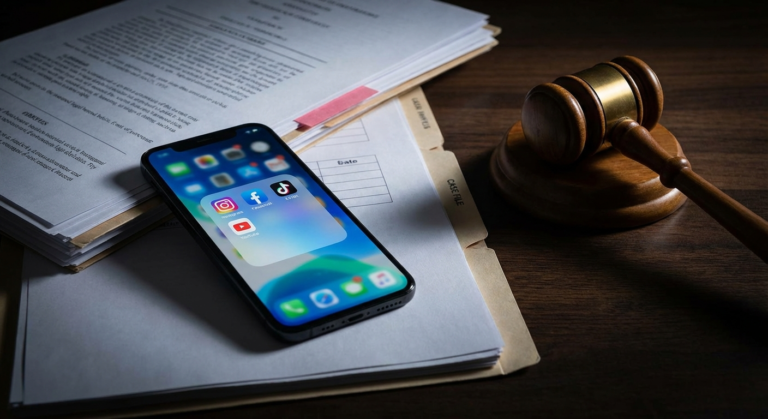
You’ve been injured in a car accident. Your back hurts, you’re missing work, and you’re dealing with medical bills. You hire a lawyer, file a claim, and wait for a fair settlement. Then the insurance company’s attorney shows up with screenshots from your Facebook page—photos of you at a cookout, a post about “finally feeling better,” or a check-in at the gym.
Suddenly, your case is in jeopardy.
Welcome to personal injury litigation in the age of social media. What you post online can—and will—be used against you. And in South Carolina, the rules favor disclosure, not privacy.
Social Media Is Discoverable in South Carolina
South Carolina’s civil discovery rules allow parties to request information that is “reasonably calculated to lead to the discovery of admissible evidence.” This standard is governed by Rule 26 of the South Carolina Rules of Civil Procedure.
That’s a broad scope—and it includes your social media.
Defense attorneys and insurance companies routinely investigate claimants’ social media accounts looking for:
- Posts or photos that contradict claimed injuries (“I can barely walk” vs. photos of hiking)
- Evidence of pre-existing conditions or prior injuries
- Check-ins at gyms, bars, concerts, or other activities inconsistent with disability claims
- Comments about the accident, the case, or the other party
- Direct messages, even those marked “private”
“But My Account Is Private”
Setting your Facebook, Instagram, TikTok, or X (Twitter) account to “private” or “friends only” does not protect you. South Carolina courts have repeatedly ruled that there is no reasonable expectation of privacy for social media content, even on private accounts.
Why? Because once you share something with friends, followers, or contacts—even a limited group—it’s no longer truly private. And defense attorneys have multiple tools to access that content:
- Subpoenas to social media platforms
- Requests for production directed at you
- “Friend requests” from fake accounts or third-party investigators
- Testimony from people on your friends list
If you refuse to produce requested social media content, the court can impose sanctions, including:
- Adverse inferences (the jury will be told to assume the hidden content was damaging)
- Dismissal of your case
- Attorney’s fees awarded to the defense
Deleted Content Can Still Be Found
Think deleting a post, photo, or comment makes it disappear? Think again.
Even deleted content can be recovered through:
- Digital forensics
- Subpoenas to social media companies (who may retain deleted data)
- Screenshots already captured by the defense or their investigators
And deleting content after you’ve been put on notice (after filing a lawsuit or hiring an attorney) can be considered spoliation of evidence—a serious issue that can result in sanctions or the dismissal of your case.
What Gets Used Against You?
You might think only obvious posts—like “I’m fine now!” or photos of you doing something physically demanding—are risky. But defense attorneys are creative. Here’s what they look for:
1. Photos and Videos
Even innocent photos can be twisted:
- Smiling at a family gathering? “Clearly not suffering.”
- Standing in a group photo? “No sign of back pain.”
- Holding a toddler? “Lifting heavy objects with no problem.”
Context is often ignored. A single photo from a good day can be used to argue your injuries aren’t as severe as claimed.
2. Check-Ins and Location Tags
Checked in at the gym, a bar, a hiking trail, or an amusement park? That can be used to argue you’re exaggerating your limitations.
3. Status Updates and Comments
Posts like:
- “Finally had a good day!”
- “Feeling better”
- “Back to normal”
- “Ready to move on”
…can all be interpreted (or misinterpreted) as evidence that your injuries have resolved or were never serious.
4. Private Messages
Yes, even DMs. If they’re relevant to your claim, they can be subpoenaed.
5. Other People’s Posts
It’s not just your own posts. Photos, tags, and comments from friends and family can also be used. If someone tags you at an event or posts a photo of you doing something inconsistent with your claimed injuries, that’s fair game.
South Carolina’s Constitutional Right to Privacy: Does It Help?
South Carolina is one of the few states with an explicit right to privacy in its state constitution (Article I, Section 10). Does that protect your social media?
Not much.
While this constitutional provision may make South Carolina courts slightly more cautious about overly broad discovery requests, it does not create a blanket shield for social media content. If the content is relevant to your injury claim, it’s discoverable—privacy settings or not.
Authentication: How the Defense Proves It’s Really You
To use social media content against you in court, the defense must authenticate it under Rule 901 of the South Carolina Rules of Evidence. They must prove:
- The account is yours
- The posts or messages were created by you (not someone else with access to your account)
- The content hasn’t been altered or taken out of context
However, authentication is usually straightforward. Your name, profile picture, friends list, and the content of posts often provide enough evidence. Case law, such as State v. Green, provides courts with detailed guidance on authenticating digital evidence.
What You Should Do (and Not Do)
If you’re pursuing a personal injury claim in South Carolina, follow these rules:
DO:
- Stop posting. Seriously. Just stop. The safest social media is no social media.
- Set everything to private. It won’t fully protect you, but it reduces casual snooping.
- Tell your lawyer everything. If there’s something problematic online, your attorney needs to know now—not when the defense springs it on you at trial.
- Preserve all content. Don’t delete anything. If you do, your lawyer needs to know immediately.
- Warn friends and family. Ask them not to post about you, tag you, or share information related to your case.
DON’T:
- Post about the accident, your injuries, or your case. Ever.
- Post photos or videos of yourself doing physical activities.
- Accept friend requests from people you don’t know. That “cute single person in your area” might be a defense investigator.
- Delete posts, photos, comments, or messages. Even if they seem harmless. Let your lawyer decide.
- Assume “private” means protected. It doesn’t.
Real-World Consequences
Insurance companies and defense attorneys mine social media for ammunition because it works. A single post can turn a strong case into a weak one. Settlement offers can drop by tens of thousands of dollars—or disappear entirely—because of a photo or comment taken out of context.
Don’t let that happen to you.
The Bottom Line
Social media can destroy your personal injury claim. What seems like a harmless post to you can be gold to a defense attorney. And in South Carolina, the law gives them broad access to your online life.
The best defense? Stay off social media until your case is resolved. If that’s not realistic, be extremely cautious, keep everything private, and consult your attorney before posting anything.
Your case—and your compensation—depend on it.
—
Hurt in an accident? Proffitt & Cox can help protect your claim.
We know how insurance companies use social media against injury victims—and we know how to fight back. Call us today for a free consultation at 803-834-7097 or visit proffittcox.com. Don’t let a Facebook post cost you the compensation you deserve.