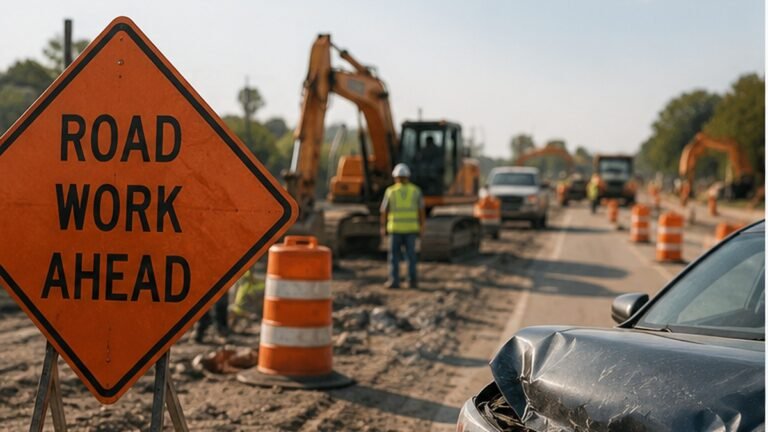
Road construction is meant to make travel safer in the long run. In the short term, however, work zones can create sudden lane shifts, narrowed shoulders, uneven pavement, changing traffic patterns, large equipment, and distracted drivers. When a collision happens in or near a construction zone, the question is not always limited to which driver hit whom.
Depending on the facts, a claim may involve another motorist, a contractor or subcontractor, a business responsible for a work site, or a governmental entity. Determining responsibility requires a careful review of the crash, the work-zone layout, the available records, and the applicable law.
Why construction-zone crashes can be different
A construction-zone crash may happen because of an ordinary driving mistake: speeding, following too closely, failing to yield, distracted driving, or ignoring a traffic-control device. But the zone itself can also be important. Evidence may reveal questions about temporary signs, lane closures, barriers, lighting, flagger instructions, equipment placement, pavement conditions, or the timing of traffic changes.
South Carolina law prohibits certain conduct in a highway work zone when workers are present and near the area involved, including driving through or around the zone in a lane not clearly designated for travel and failing to obey traffic-control devices erected to control traffic flow. The statute includes specific exceptions and limitations. S.C. Code § 56-5-1535. A traffic citation—or the absence of one—does not decide every civil claim.
Who may be involved?
Another driver
Many work-zone crashes still begin with driver conduct. A driver may fail to slow for congestion, merge unsafely, disregard a closure, or use a phone while traffic patterns change. The police report, witness accounts, vehicle damage, available video, and electronic data can all help clarify what occurred.
A contractor or subcontractor
Road work is often performed by private companies under contract. If the work-zone setup, signage, temporary traffic-control plan, or operation of construction equipment contributed to a crash, the conduct of a contractor or subcontractor may need review. That does not mean every contractor is responsible for every collision in a work zone. Responsibility depends on the specific facts, contractual duties, safety requirements, and evidence.
A governmental entity
A state agency, county, municipality, or other public entity may be connected to a roadway project. Claims involving public entities can raise different legal rules, including statutory limits, exceptions, and timing provisions under South Carolina’s Tort Claims Act. S.C. Code ch. 15-78. The applicable rule depends on the facts, the entity, the legal theory, and current law.
Because government-related claims can be time-sensitive and fact-specific, it is important to seek legal advice promptly rather than assuming the same rules apply as in an ordinary two-car collision.
A business or property owner
Not every work zone is a highway project. Construction near a business entrance, apartment complex, parking area, or private road can present different questions about who controlled the site, who placed warnings, and whether a dangerous condition was created or left unaddressed.
Evidence can disappear quickly
Work zones change. A lane closure, temporary sign, barrier pattern, detour, or traffic-control setup visible on the day of the crash may be gone days later. That is why early evidence preservation matters.
If you are physically able and it is safe to do so, consider preserving:
- Photos and video of the roadway, signs, barrels, cones, barriers, lighting, and lane markings;
- The exact location, direction of travel, time, weather, and traffic conditions;
- Names and contact information for witnesses;
- The police report number and responding agency;
- Images of involved vehicles and visible damage;
- Information identifying contractors, project signs, vehicles, and equipment; and
- Medical records, bills, and documentation of missed work or other losses.
Avoid entering an active work area or putting yourself at risk to gather evidence. Your safety comes first.
Do not assume the police report tells the whole story
A collision report can be an important starting point, but it may not capture the full condition of a work zone or every relevant party. For example, a report may identify the drivers but not explain whether a temporary traffic-control setup changed that morning, whether a sign was obscured, or which contractor controlled the relevant portion of the project.
A timely review may involve photographs, 911 records, roadway plans, project documents, witness information, surveillance footage, vehicle data, and other evidence. The right evidence depends on the crash.
Practical steps after a construction-zone crash
- Get medical attention. Some injuries are not immediately obvious. Follow up with qualified providers and follow recommended treatment.
- Report the collision. Cooperate with law enforcement and ask how to obtain the report number.
- Preserve what you can safely preserve. Save photographs, dashcam footage, and witness information.
- Do not sign a release or accept a settlement without consulting an attorney.
- Act promptly. This is particularly important if a public entity, contractor, or unusual roadway condition may be involved.
Talk with a South Carolina injury lawyer about the facts
Every crash is different, and this article cannot determine who is legally responsible for a particular accident. If you were injured in a South Carolina construction-zone accident, Proffitt & Cox can review the circumstances, discuss the issues that may matter, and explain whether the firm can help.
Call Proffitt & Cox at (803) 834-7097 to discuss your situation.